Hendrix Hennessy-Ropiha, Keita Newbery, Ben Girven, Abigail Hau, Tiana Krafft-Soffe, Vanessa Green, Renati Waaka, Jazmin Tainui Mihi
Māori Camera Club
17 Oct — 04 Dec
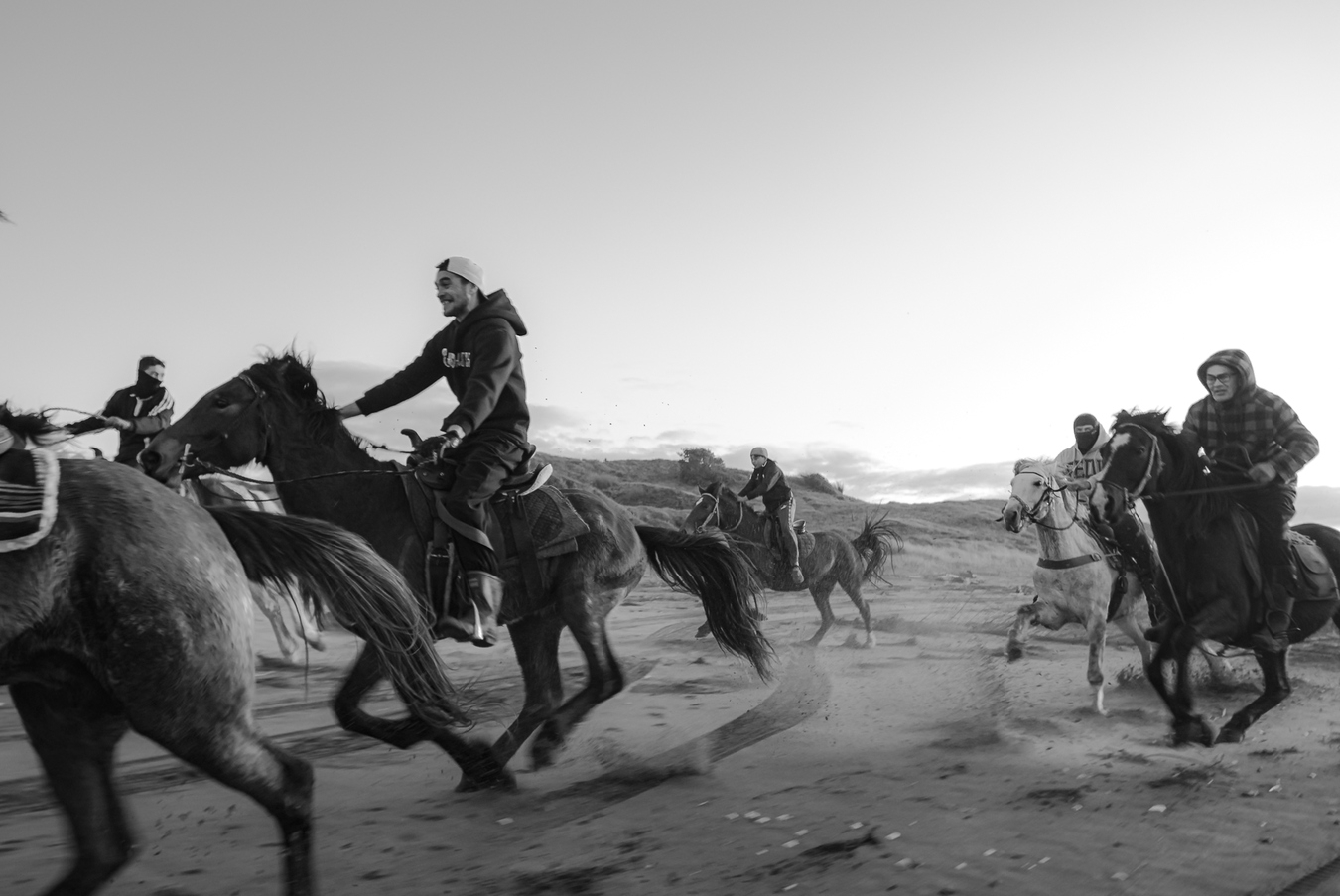
Jazmin Tainui Mihi. Taniwha Chasers, 2024. Image courtesy of the artist.
Māori Camera Club
17 October – 4 December
*Please note there is no opening for this exhibition. An artist floor talk will be held on Saturday 31 October at 1 pm.
Māori Camera Club is the inaugural exhibition for the members Hendrix Hennessy-Ropiha, Keita Newbery, Ben Girven, Abigail Hau, Tiana Krafft-Soffe, Vanessa Green, Renati Waaka, and Jazmin Tainui Mihi. The group exhibition presents a selection of new and existing lens-based works by the members.
What exactly is a Māori Camera Club? Aside from the intent and need for professional development through peers who practice in the same discipline, it also offers the opportunity to bring together a vantage point that is not siloed to their rohe. The starting point to rewrite the encounter between toi Māori and photography was the exhibition Site Seeing by the founding members of the club, Conor Clarke and Bridget Reweti, which was held at the National Library in Wellington in 2025. For the previous exhibition, Reweti’s work through the fog it came and the slice of the sea (for Sarah), 2023 presents a pounamu plate negative with the silhouette of an albatross. The material collision of the plate hybridises the medium without seeking resolution. The work hinted at the larger contradiction of an imperial tool which surveyed the whenua and the flora, fauna and tangata whenua. There is a playful interrogation of both toi Māori and photographic histories in Reweti’s work, and this is further compounded by a mountain reveals a mountain, 2022 by Clarke, in which the portrait of a sandcastle on the beach questions structures like pepeha and our construction of identity. Their exhibition and works are an important foundation for my definition of Māori photography.
In te reo Māori, the word for photograph is whakaahua. In Ben Girven’s works, he understands this through Natalie Robertson’s framework, Towards a Māori creation narrative camera model, but in reverse with his contact print. Girven is informed by the Kahungunu maramataka methodology, in which the images describe a living visual diary that grows with us, and our environment. His mahi is further expanded into another cosmic dimension in Te Kōpu o te Taiao by Tiana Krafft-Soffe. The three-channel moving-image work also features movement artist Sylvie Aroha (Ngāti Kahungunu ki Te Wairoa) and builds on Krafft-Soffe’s background in contemporary dance and ballet. Te Kōpu o te Taiao is a pedagogical framework, the universal origin of all Māori relationships, be it Te Tai Ao, tangata, ātua or, for Krafft-Soffe, a visual choreography of wai.
Renati Waaka offers an image of Māori boyhood that I recognise from swimming in the same Kaituna awa, close to where my father lived in Paengaroa. The image of the boy emanates Te Arawa pride through the many lakes and rivers that surround the motu. However, Waaka’s image of home and self has been filtered through pop culture references. This is my best friend Guillaume. It’s French for William…He’s Samoan. I often wonder why his name isn’t Viliamu mirrors a Drake album cover; Solange, his TikTok For You Page and depressing gay movies also inform Waaka’s portraits.
Keita Newbery’s works are taken on a visit to her marae in Tūhoe country. They hold a reminder of Peter Peryer’s photograph Two Goats, with a sense of being out-of-time. This is a version of Aotearoa that is obscured in urban centres. However familiar parts of Newbery’s photographs are, they are difficult to parse for a casual viewer. This dimension of refusal images her Tūhoe identity and a relationship of intent to place.
In 1884, Hennessy Ropiha’s tipuna Hori Rōpiha accompanied Tawhiao Tukaroto Matutaera Te Wherowhero, the Māori King, on his journey to England to meet with the Queen about renewing the promises of Te Tiriti. Hori was an esteemed rangatira of Ngāti Kahungunu and Rangitāne. However, the voyage was unsuccessful, resulting in a stalemate between hapū and Crown. Hennessy Ropiha’s series 1840 interrogates related events, definitions and objects that have formed a standard narrative of colonisation. These large-format photographs reflect an identification from the artist with their subject matter, but simultaneously, a desire to untangle oneself from such narratives – and the enduring impasse of resistance.
Taniwha Chasers by Jazmin Tainui Mihi are cowboy photographs. They antagonise Hennessy Ropiha’s images through their evasion of this history, instead exuding mana. The horse turns its eye back on the viewer. These rangatahi Māori have a strong connection with the wild horses of Ōpotiki, the hometown of the artist. Māori have held a long and historic connection to horses. Although they were used as a tool to colonise Aotearoa, they have since been reclaimed as part of our whakapapa.
Abigail Hau’s work resulted from their advocacy for Te Tai Ao and a deep concern for the health of the whenua. Being out hiking is an essential part of Hau’s process – this slow time with the environment is a crucial step in her analogue photographs. Punaruku I and II developed from their first visit to where they whakapapa to. They appear like night vision images, steeped in red and vibrating with the rich pigments of the whenua.
Kaputuhi Pā was photographed by Vanessa Green during a visit to her marae for Te Kawau Mārō o Maniapoto in 2024. The portrait of the marae positions the viewer from the approach of manuhiri arriving to be called on. The backdrop of the hills and the green of the pasture are emblematic of the Waikato, as is the neatly mown lawn. The wharenui has become synonymous with our identity, but the questions seem to no longer be about reclaiming our identity, which I associate with the work of our modernists, but perhaps proximity, as our whakapapa is there and certain.
A Māori Camera Club is such a Western idea of collectivity and reminds me of sporting clubs that my father enjoyed, like the Te Puke Golf Club that he was a member of with his friends. A fellow image-maker said he wouldn’t want to join the club because photographers are too uptight (and I say this as someone who studied photography and practices photography). It has an artistic rigour, or say perfectionism, in which dust and whenua don’t seem to mix. But a Māori Camera Club’s concern is with the ambition for rangatahi to ride at sunset, to reinvent the methodology of our approach to whakapapa, through visualising the cosmology of Māori photography together.
The club was founded by members Bridget Reweti and Conor Clarke and the exhibition was curated by James Tapsell-Kururangi.
Ngā mihi nui ki exhibition partners The Chartwell Trust and National Services Te Paerangi. Thank you to Signtech and Christchurch Art Gallery Te Puna o Waiwhetū for the assistance in realising this exhibition.
To coincide with the exhibition, Māori Camera Club will be running their second wānanga in Ōtautahi. They would like to thank all who supported their mahi through the Boosted campaign and key funders Toi Ōtautahi and National Services Te Paerangi.
Hendrix Hennessy-Ropiha (Ngāti Kahungunu, Ngāti Raukawa) is a Wellington-based artist working with photography. His practice often revolves around social and political currents within Aotearoa and how art can examine these in different ways. Recent exhibitions include 1840 at McLeavey Gallery (2026), Pahemata in the Courtenay Place Lightboxes (2026) and We can travel only a short way together in Levin (2025).
Keita Newbery (Ngāi Tūhoe, Ngāti Porou) is an Ōhinehou-based photographer working with black and white analogue photography. Her mahi focuses on our natural taonga resources, as well as the moments when the marae is still, the ‘in-between times’ so to speak. While the roles and responsibilities of tiaki taiao and manaakitanga are never laid to rest, her work speaks to the importance of tāoki.
Ben Girven (Ngāti Kahungunu ki Wairoa) is a contemporary art photographer, engaging the camera-less medium of the photogram. His whakaahua take form on location, with a pulse of light, in whenua, ngahere, awa and moana, embodying maramataka as methodology. Girven extends perceptions of wā , light and energy, exploring relational spaces activated in wānanga, through connection with art, and each other. Te taiao is creator, camera, and darkroom, blurring the distinction between the agents of photographic engagement and affirming whakaahua to be an Indigenous medium. He received a Bachelor of Design in Mātauranga Toi Māori and Photography, and a Master of Fine Arts at Te Kunenga ki Pūrehuroa, Massey University.
Abigail Hau (Ngātiwai, Ngāpuhi) is an analogue photographer born and based in Otautahi. Their photography is shaped by the principles of kaitiakitanga, and rooted in connection to whenua, and to people. Abi works exclusively with analogue processes, including photography, moving image, and darkroom printing. Their practice is slow, embodied, and relational, focussing on decolonising the lens. Through this, they honour their connection to the whenua, to whakapapa, and to the mauri they capture. Recent exhibitions include Iti noa ana he pito mata by Browntown (2025), He Wāhanga nō te Kōrero at Te Whare Tapere (2026) and E lē galo le tai at COCA (2026).
Tiana Krafft-Soffe (Hihifo, Te Ātiawa, Ngāti Apa, Ngāti Kuia) is a multi-disciplinary artist, weaving together movement, lens, sound, and digital processes. Her practice centres movement of the body as an intuitive and genealogical pathway to knowledge. Incorporating visual and sonic artforms, Tiana shares her understanding of the being as multi-dimensional, to ignite a deepened bodily awareness. Tiana has trained in contemporary dance and ballet, and has completed a Bachelor of Design majoring in Mātauranga Toi Māori and Photography. She is currently working towards completing a Master of Fine Arts at Te Kunenga ki Pūrehuroa, Massey University.
Vanessa Green (Ngāti Maniapoto) is a photographer based in Tāmaki Makaurau. Her work moves between environmental portraiture, social documentary and the everyday moments in between. She often photographs people in their homes, neighbourhoods and other familiar surroundings. Vanessa works in a gentle and observational way, making photographs that feel honest and intimate. As a wahine Māori, she is interested in the relationships between people, whenua and community, and in how memory, belonging and a sense of home are carried through place.
Renati Waaka is a photographer of Te Arawa, Tainui, and Te Aupōuri descent, based in Te Whanganui-a-Tara, Aotearoa. His practice examines photography’s role in the colonial construction of queer Indigenous identity in Aotearoa. Waaka uses photography to intervene in this legacy by producing images grounded in Māori perspectives, asserting authorship and tino rangatiratanga.
Jazmin Tainui Mihi (Te Whānau-ā-Apanui, Ngāpuhi, Ngāti Hine, Whakatōhea) is a Māori multi-media creative and visual storyteller. Their mahi toi centres the celebration of Māori and Indigenous culture by fostering mana motuhake and reclaiming of visual narratives utilising the lens to better her community.